
ProLine™ SmartForce Push-Out Test System
The new standard in nut and bolt weld testing.
If you’re welding nuts or bolts to stamped metal parts and you care whether those welds hold — this is the system you’ve been waiting for. The ProLine™ SmartForce Push-Out Test System delivers precision destructive weld testing with onboard data logging, customizable part profiles, password-protected settings, and label printing for full traceability. All in a system built tough enough to handle daily production environments and smart enough to eliminate the guesswork that plagues older test setups.
Push-out tests are sometimes called push-off tests. Same test, same physics, same result. We use both terms because your engineers probably do too.
Built around the meter. Backed by the stand.
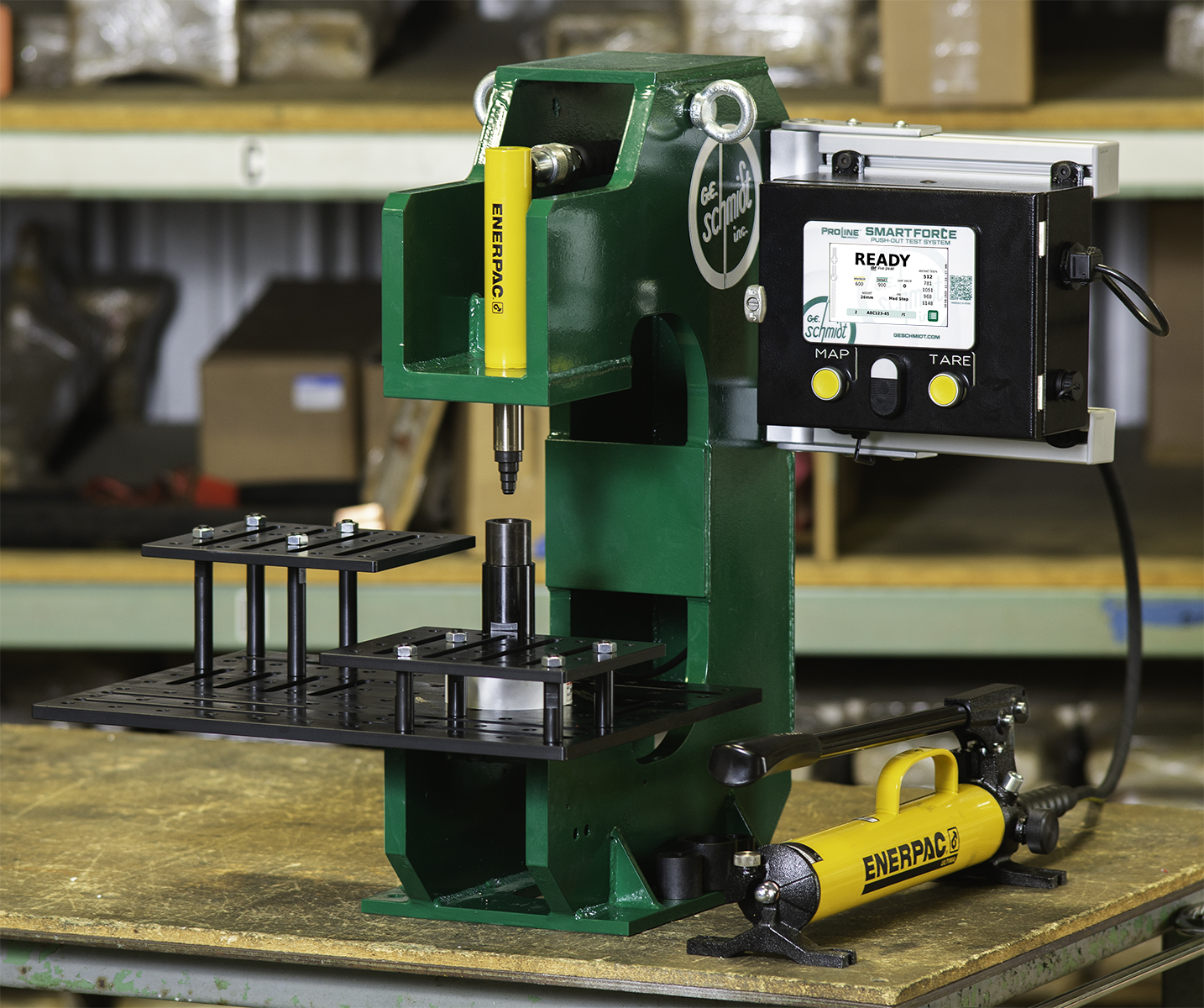
The SmartForce is two things working together, and the hierarchy matters: an intelligent touchscreen meter — developed from scratch by G.E. Schmidt’s engineering team — running on a precision C-frame stand built to match its precision without flinching.
The meter is the system. The programming, the profile logic, the run modes, the output structure — that’s G.E. Schmidt’s own design, and it’s not something you can replicate by bolting a load cell to a hydraulic press. The stand exists to give the meter a platform worthy of it: zero deflection, precise platen alignment, and a 2.5x safety factor so nothing in the frame limits what the measurement can do.
The Meter
The SmartForce meter is where the intelligence lives — and it’s what separates this system from everything else in its class. Every feature, every run mode, every output format was designed by G.E. Schmidt specifically for nut and bolt weld verification. There is no off-the-shelf version of this.
Standard Features
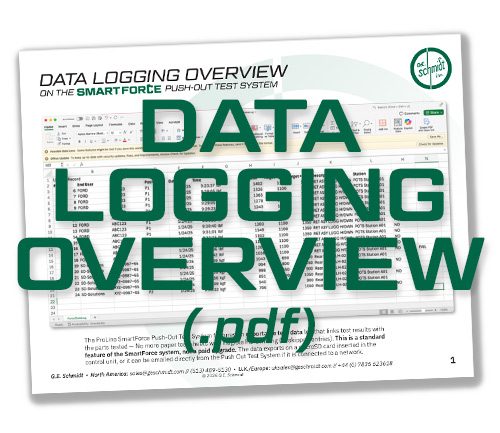
On-Board Data Logging Every test is automatically recorded with date, time, force measurement, part profile, and operator context. Data exports as a .CSV file, fully compatible with Excel. Sort by part number, date range, shift, or operator. No proprietary software required. Your data is yours, in a format your team already knows how to use.
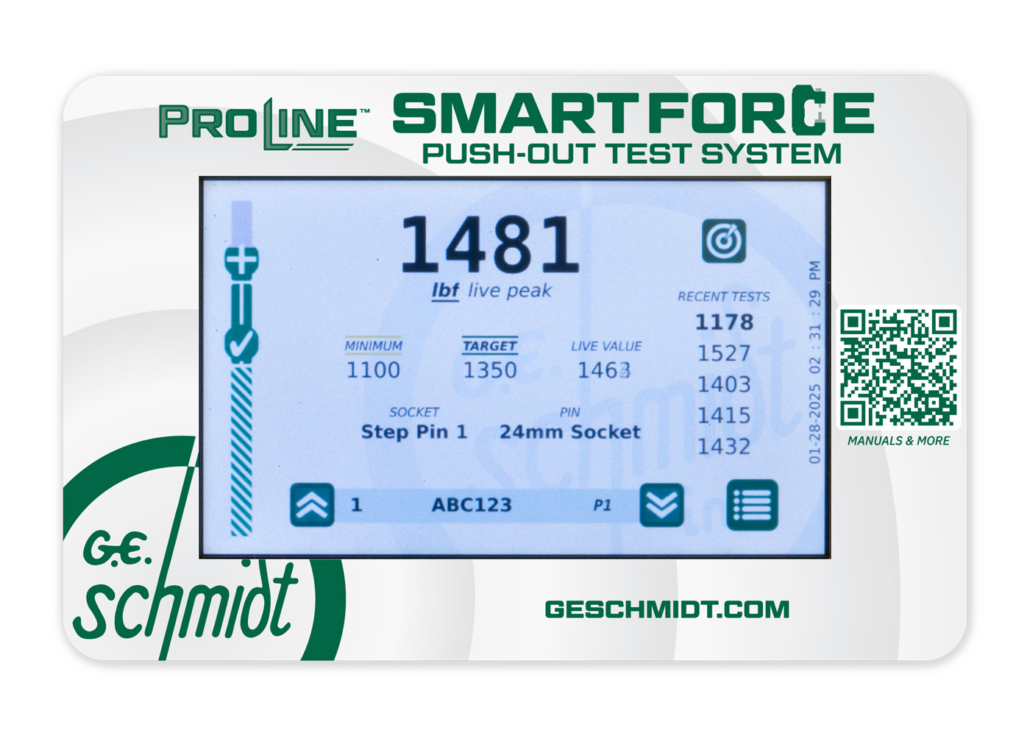
5″ Touchscreen Interface A live graphic guides the operator through each test and displays real-time force readings as they happen. No squinting at an LCD. No ambiguity about whether you hit the minimum. Pass or fail is clear before the operator lifts a hand.
50 Weld Profiles with WeldID Maps Store up to 50 customized part profiles, each with target minimums, safety buffers, tooling specs, and units of measure. Attach part diagrams with weld location identifiers so operators know exactly where to test and what to expect — shift to shift, month to month, project to project. Consistency isn’t hoped for. It’s built in.
15+ Standard Sockets and 9+ Standard Pins A comprehensive tooling library covers the most common fastener sizes right out of the box, with OEM-spec tooling available for applications that require it. Tests are performed the same way, every time.
Password Protection Operators can switch profiles, tare the unit, and run tests. They cannot change testing specifications without authorization. The settings that matter stay locked down.
Adjustable, Movable Meter Mount Mount the meter on either side of the stand or on a nearby benchtop. The display goes where your workflow needs it, not where it’s convenient for the manufacturer.
Physical Profile Select, Tare & Part Map Buttons Dedicated physical buttons keep operators’ hands off the screen for high-volume testing environments. Less screen wear. Fewer errors. Faster cycle times.
The C-Frame Stand
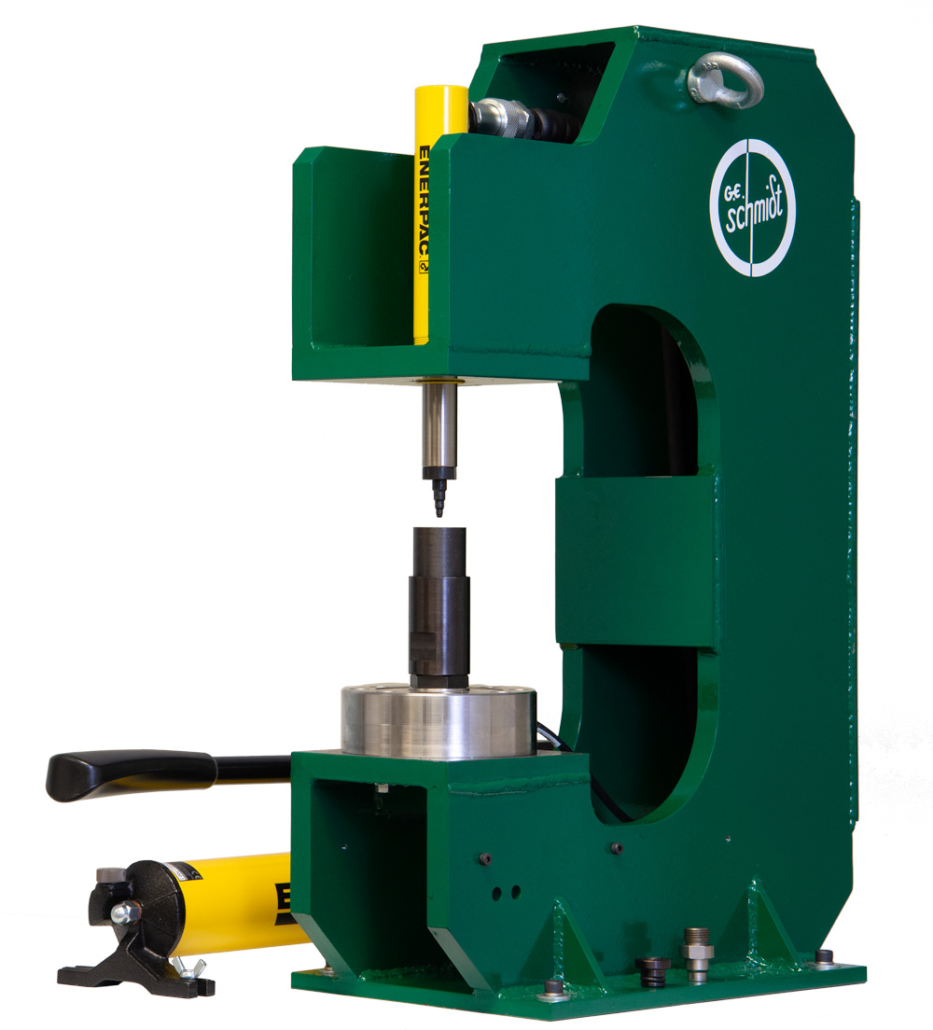
The SmartForce C-frame was engineered from the ground up to hold up its end of the bargain. A 2.5x safety factor at 10,000 lbs. force, precisely aligned upper and lower platens, and zero deflection at the top of the force range mean the stand never becomes the weak link in your measurement. When the meter says 9,800 lbf, the frame didn’t flex to get there.
Force capacity options: For most resistance welding applications — weld nuts, weld bolts, standard projection fasteners — the 10K is the right configuration. It’s what we stock and what most customers run. We also offer purpose-built units for lower-force applications like clinch fastener testing where accurate break force measurements are needed in the 100-300 lbf range. Higher-force units are also available for full-ring projection welds, bulkhead applications, and other specialized geometries where breaking force is high. GES will walk through your specific application before making a recommendation — that’s part of what the demo conversation covers.
Hydraulic ram with hand pump standard. A two-stage pump for faster actuation and a pneumatic-hydraulic foot pedal are available as options.
Interchangeable test pins — step pins, flat heads, concave faces, and custom/OEM-specific designs — handle everything from standard hex weld nuts to specialized fastener geometries.
Sockets sized at fastener diameter + 4mm ensure consistent support geometry across all fastener sizes.
Custom part holders and fixtures are available for heavy, unwieldy stampings where keeping hands out of the test zone is a safety requirement, not just a convenience.
Options & Upgrades
The SmartForce is fully capable out of the box. These options extend it for specific workflows and environments.
Modular Tooling Base & Plates If you’re testing actual production parts rather than material coupons cut specifically for testing, this matters. Production stampings come in all shapes and sizes — some are manageable, some are unwieldy beasts, and very few sit flat and stable on their own under a hydraulic ram. The modular tooling base provides a stable platform with holes, slots, and 45mm extrusions for building custom part rests and hold-downs for whatever geometry you’re working with. Parts stay positioned correctly, operators’ hands stay out of the test zone, and tests are consistent sample to sample. If your parts go straight from the production floor to the tester without being cut down first, this option isn’t really optional.
Label Printer for Test Labeling The SmartForce label printer option replaces that with a complete, auto-generated test record printed and stuck to the part the moment the test ends. Full details in the SmartForce Printing section below.
Two-Stage Hand Pump The standard hand pump works. The two-stage pump works dramatically faster — and the difference is more significant than it sounds. Most of the time in a push-out test isn’t spent applying force; it’s spent moving the ram from its resting position down to contact with the part. The two-stage pump uses a high-volume stage for fast ram descent and automatically shifts to high-pressure mode the moment it senses resistance — no operator input, no mode switching, no fumbling. The result is a test cycle that’s a fraction of the time of a standard single-stage pump. See the video comparison at left.
Pneumatic-Hydraulic Foot Pedal Hands-free initiation for high-volume testing or applications where both hands are needed to position the part.
Custom Test Tooling and Fixtures Specialty pins, rests, and holders for difficult geometries or difficult-to-access weld locations. Contact us with your application.
High Force (20k+ lbf) and Deep Clearance Frames The standard SmartForce C-frame handles nearly everything. Some applications — extreme force requirements, unusual geometries, deep clearance needs — require more. We can help.
Additional Calibration Certifications NIST-traceable calibration is standard. Advanced certifications including A2LA are available for customers with stricter compliance requirements.
Stack Lights for Alert Visibility Pass/fail status visible from across the floor. Useful in high-noise environments where watching the screen isn’t practical.
7″ Touchscreen Interface A larger display for distance readability or environments where operators work with gloves or face shields.
Dedicated Pedestal Stand The SmartForce is bench-ready out of the box — most customers set it on an existing quality bench and get to work. But the unit weighs over 200 lbs., and not every facility has a bench rated for that. The optional pedestal stand gives you a purpose-built, stable mounting solution at working height without the hassle of sourcing and installing a heavy-duty table. If you’re setting up a dedicated test station, this is the clean way to do it.
SmartForce Printing: A Test Record That Travels With the Part
Here’s the current workflow at most facilities running push-out tests: the operator tests a part, reads the force value off the meter, and writes it on the part with a Sharpie. One number. No minimum spec. No pass/fail. No timestamp. No operator ID. No calibration status. Just a number in marker that tells the next person in the process almost nothing they actually need to know.
The SmartForce label printer option replaces that entirely. Connect an off-the-shelf label printer (sold separately) via direct connection or network, and the SmartForce automatically generates and prints a complete adhesive test record the moment each test ends — with no additional steps from the operator.
Each printed label captures:
- Part number and weld position identifier
- Actual force result
- Pass/fail status against the profile minimum
- Date and time of test
- Calibration expiration date
- Station ID
- QR code linking to SmartForce service and support resources
Two print modes are available. Manual mode prints on a single button press after the test — useful when operators are testing at a measured pace or want to review before printing. Auto mode prints immediately and automatically after every test — the right choice for high-volume operations where speed and consistency matter more than review.
Whether parts are staged for re-inspection, moved to an audit area, or held for disposition — every part carries a complete, unambiguous record of its test. No transcription errors. No “I thought it passed” conversations. No gaps when an auditor asks what happened to part number 47 on the Tuesday afternoon shift.
This is how you close the loop between testing and traceability without adding a documentation burden to your process. The record generates itself.
Why Push-Out Testing? (And Why Not Torque?)
If you’ve been using torque tests to verify weld nut and weld bolt quality, you’re not testing what you think you’re testing.
What a torque test actually measures
Torque testing was never designed to evaluate a projection weld. It was designed to verify joint clamp load during assembly — a different problem entirely.
When applied to weld nut verification, torque tests work by threading a bolt into the nut and applying a specified torque value. The problem is fundamental: torque is a function of friction as much as weld strength. The standard formula — T = F × K × d — requires an accurate friction coefficient (K) for the result to mean anything. That K value varies by 20% or more depending on thread lubrication, surface condition, burrs, material grade, and plating. Same part, same weld, different day: different torque number.
The deeper problem is the failure mode. A projection weld nut fails in service when the projections pull away from the base material under axial load. Torque testing — whether applied through the threads or to the outside of the nut body — never loads the weld that way. You’re applying rotational force to a joint that fails under axial force. You can pass a marginal weld because the threads were oily. You can fail a solid weld because the bolt was dry. Neither result tells you anything reliable about the weld.
What a push-out test actually measures
A push-out test applies direct axial force to the weld joint — no threads, no friction variable, no K-factor ambiguity. The test loads the weld exactly the way it fails in service and measures one thing: the force required to separate the fastener from the base material. That is the weld. Nothing else.
The result is repeatable, traceable, and directly comparable across shifts, operators, and time. It reflects changes in weld schedule, electrode wear, material variation, and projection condition in a way torque never can. AWS C1.1 and experienced projection welding engineers consistently point to push-off testing as the more consistent and meaningful method for destructive weld evaluation — precisely because it tests the right variable.
When torque still has a role
Torque testing isn’t useless. It has a legitimate place in final assembly verification and in-process checks where you’re confirming joint clamp load, not evaluating weld integrity. But as the primary method for establishing and monitoring weld quality in a projection welding operation, it is the wrong tool for the job.
Push-out testing is the right tool. The SmartForce is the best implementation of it.
Who Uses the SmartForce
The SmartForce is in use across industries wherever projection-welded fasteners are load-bearing and tolerance for failure is low.
Automotive — Body-in-white, chassis, brackets, and subassemblies with weld nuts and bolts throughout. IATF 16949 traceability requirements make the SmartForce’s data logging and printing capabilities especially relevant.
Aerospace & Defense — Applications where weld quality documentation isn’t optional.
Appliance Manufacturing — High-volume nut welding where consistent process monitoring prevents field failures and warranty costs.
Electronics & Industrial Equipment — Lower-volume, higher-precision applications where part profiles and documented test history add value throughout the production lifecycle.
If you weld nuts or bolts to metal stampings and those fasteners have to hold — this conversation is worth 30 minutes of your time.
Frequently Asked Questions
What’s the difference between a push-out test and a push-off test? Nothing. The terms are used interchangeably in the industry. Both refer to the same destructive test methodology: applying direct axial force to separate a welded fastener from its base material.
What force capacity do I need? It depends on your fastener mix, sizes, and your customers’ minimum weld specs. The 5K configuration is right for most M10 and smaller fasteners — and if the highest minimum spec in your application is 4,000 lbf, there’s no reason to buy more machine than that. The 10K covers larger fasteners with higher spec requirements. The 15K is built for full-ring projection and bulkhead-style welds where breaking force is genuinely high. GES will walk through your specific application before recommending a configuration — that’s part of what the demo conversation covers.
Can the SmartForce test weld bolts as well as weld nuts? Yes. The system is designed for both. Tooling selection varies by fastener type and size. Standard tooling covers most common configurations; custom tooling is available for OEM-specific fasteners.
How does data export work? Test data exports as a standard .CSV file. When connected to a network, results can be emailed directly from the meter. Exported files are fully compatible with Excel — no proprietary software, no license fees, no locked format.
Is calibration NIST-traceable? Yes, standard. A2LA and additional certifications are available as options.
What’s the footprint of the system? The SmartForce C-Stand has a compact footprint suitable for a quality bench or dedicated test station. The optional pedestal stand is available for customers who need a purpose-built mounting solution. Contact us for full dimensional specifications.
Do you offer custom tooling for unusual fastener geometries? Yes. If your application uses non-standard fasteners, unusual weld locations, or challenging stamping geometries, our engineering team can develop custom tooling and fixtures. Contact us with your application details.
Why is the SmartForce meter different from other load cell-based testers? The SmartForce meter was developed from scratch by G.E. Schmidt’s engineering team — the programming, profile logic, run modes, and output structure are proprietary. This isn’t a commodity load cell with generic firmware. Every feature was designed specifically for nut and bolt weld verification, which is why the workflow, the data outputs, and the traceability capabilities work the way they do.
Can I see my own parts tested during the demo? Yes. Pre-ship a sample of your parts before the session and we’ll test them live during the demo. You’ll see the actual force readings for your actual fasteners, with your weld specs loaded into the profile. It’s the most direct way to answer the question of whether the SmartForce is right for your application.
What does the virtual demo cover? A 30-minute live virtual demo walks through the full system: meter interface, profile setup, a live test, data export, and label printing. You’ll see exactly what your operators would see on day one. Most customers who see it running have their questions answered before the demo ends.