

Excessive Indentation in Resistance Welding
Excessive indentation occurs when the electrode depression on the workpiece surface exceeds the depth specified by the manufacturer or applicable weld classification standard. Because some indentation is inherent to the resistance welding process, the threshold for “excessive” depends on the classification in use — Class A, Cosmetic, Common, and similar designations each carry different tolerances — and may differ between the upper and lower faces of the joint.
Part drawings will often specify acceptable indentation limits directly, and those drawing callouts should be treated as the controlling requirement where they exist.
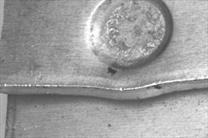
Certain electrode configurations produce asymmetrical indentation by design. A truncated cone paired with a flat cap, for example, will leave dissimilar impressions on each side of the workpiece. This is expected behavior and should be accounted for when establishing acceptance criteria.
Detection
- Visual inspection
- Dimensional measurement against the applicable manufacturer’s specification or part drawing callout
Why It Matters
Beyond appearance and fit-up, excessive indentation can indicate that too much heat or force was applied during the weld cycle — conditions that may produce a weak joint even when the weld nugget looks acceptable on the surface. Depending on severity and frequency, it can also introduce maintenance and throughput impacts.
Possible Causes
Strong Possibilities
- Electrode faces not parallel to workpiece
- Excessive sealer
- Poor or varying part fit-up
- Weld current high
- Weld force high
- Weld time long
Weak Possibilities