

Cracks and Holes in Resistance Welding
Cracks and holes in resistance welding are discontinuities within the weld nugget or surrounding material caused by metallurgical changes during the weld cycle. They are also referred to as fissures (cracks), voids, or pores (holes), depending on their form and location.
Where They Form
Holes may be contained within the nugget at the weld center, or distributed around the nugget edge at the sheet interface — a pattern sometimes associated with interfacial expulsion. Surface cavities can also form as a result of heavy surface expulsion.
Surface cracks typically radiate from the approximate center of the nugget and in severe cases may penetrate the full thickness of the weld zone. Cracks internal to the nugget tend to be more random in orientation. Cracks may also appear in the base material immediately surrounding the nugget.
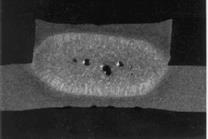
Detection
Surface cracks and holes are often visible before testing. Discontinuities at the sheet interface will not be visible until after teardown. Defects within the nugget require teardown or cross-section to detect.
Why It Matters
Cracks and holes can directly affect weld performance depending on their severity and position. Discontinuities at the edge of the weld interface are particularly concerning — they can serve as initiation points for crack growth during destructive testing and, by extension, in service. The condition can affect quality, cost, throughput, and maintenance depending on how it manifests in production.
Where to Start Troubleshooting
The strong-possibility causes group into three areas. Start here before working through the full cause list.
Weld parameters — too much heat, not enough time — High weld current and short hold time are the most common contributors. Excessive current generates more heat than the material and electrode geometry can manage; short hold time means the nugget hasn’t solidified under pressure before the electrodes retract. Short squeeze time is related — if the electrodes haven’t fully seated before current flows, pressure distribution is uneven from the start. Check your weld schedule against your material and thickness specs, and verify that squeeze, weld, and hold times are all within range.
Cooling and force — inadequate restraint during solidification — Insufficient cooling and low weld force both reduce the system’s ability to contain the molten nugget during solidification. Low force in particular allows the nugget to expand without adequate confinement, which promotes void formation and cracking. Verify cooling water flow and temperature at the electrode, and confirm electrode force against your weld schedule spec.
Electrode condition and air/hydraulic system — Incorrect electrode dressing changes the contact area and current density at the weld face, which can push localized heat beyond what the material can tolerate. A defective air or hydraulic system introduces force inconsistency — if force drops or varies during the weld cycle, the nugget loses confinement at the worst possible moment. Inspect electrode face geometry and verify system pressure and response.
Full Cause List
Strong Possibilities
- Defective air or hydraulic system
- Hold time short
- Incorrect electrode dressing
- Insufficient cooling
- Squeeze time short
- Weld current high
- Weld force low
Weak Possibilities