

Force Gauges for Resistance Welding
G.E. Schmidt supplies force gauges for resistance welding from two product lines: the Tuffaloy DLC Series digital gauges and APS customizable gauges. Both give you a direct measurement at the weld point — the only number that actually controls weld quality.
Tuffaloy DLC Series Digital Force Gauges
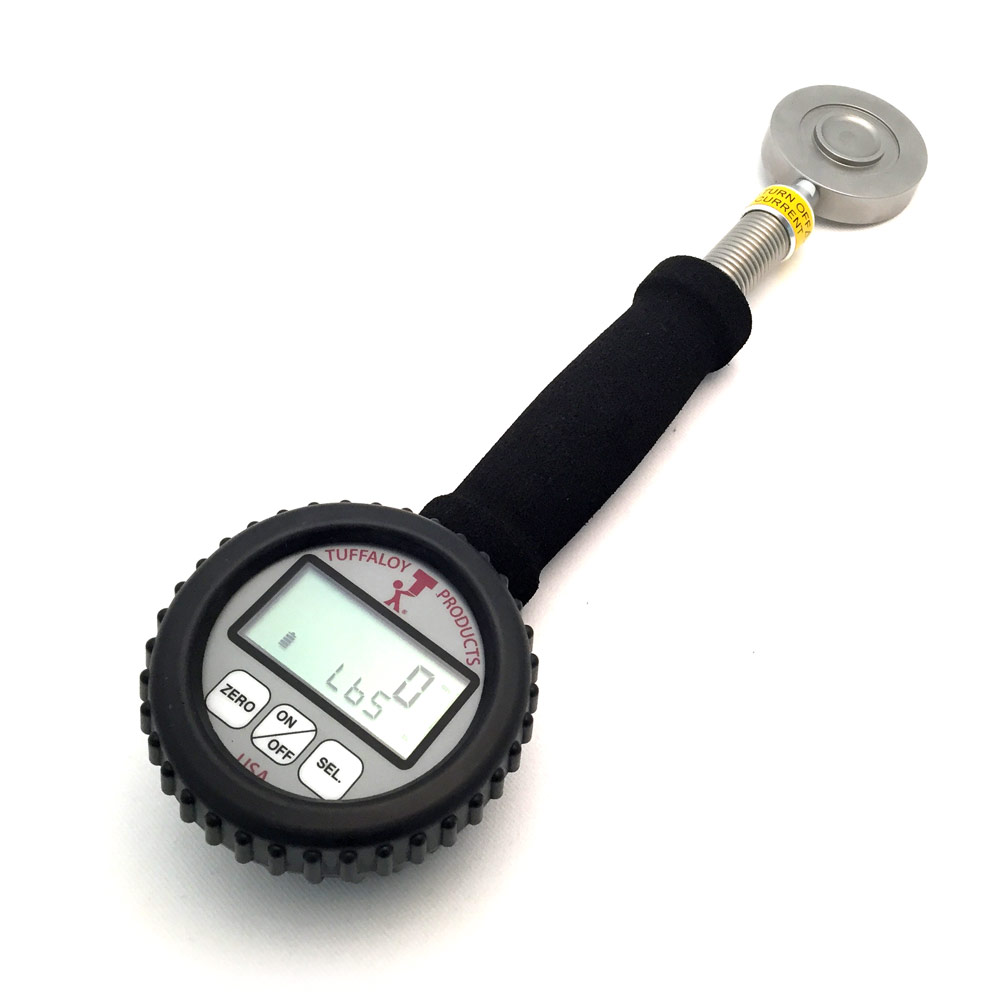
The Tuffaloy DLC Series provides fast, direct force measurement at the electrode with a digital readout and 0.5% accuracy. The meter reads in 0.5 seconds and displays in pounds, kilograms, newtons, or kilonewtons.
The load cell landing pad is slightly raised to accommodate backup and swivel electrodes and requires only 9/16-inch clearance between the electrode faces. The load cell is rated to withstand 150% of its rated load capacity.
Two models are generally in stock for immediate shipment:
- 601-5000DLC — 5,000 lb. maximum capacity
- 601-3000DLC — 3,000 lb. maximum capacity
Both include a traceable NIST certification. Recertification services are also available.
APS Force Gauges
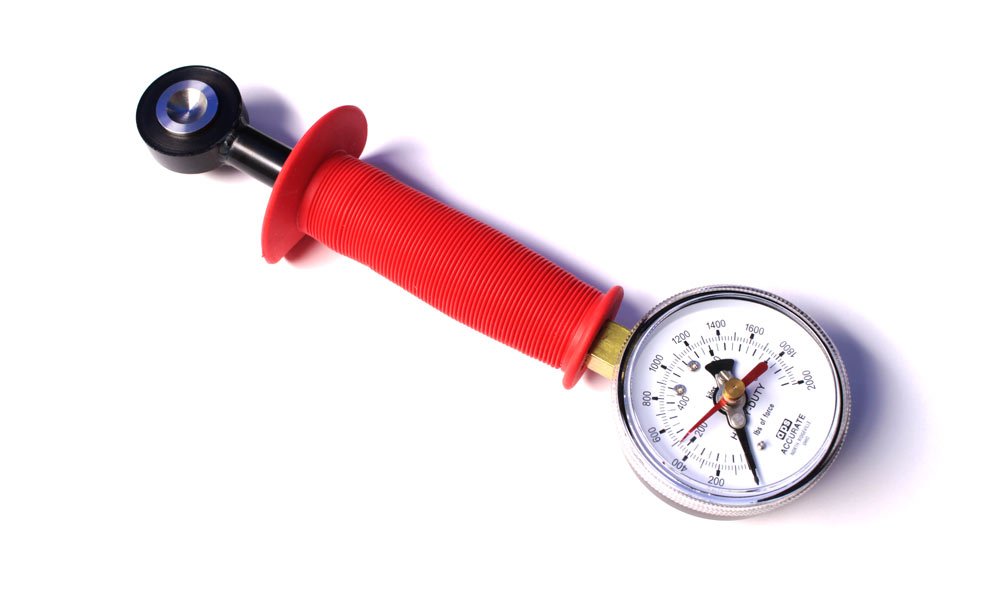
Accurate Products and Services (APS) produces a fully customizable line of force gauges for resistance welding and other industrial applications. Standard Size 1 welders with a 5.5-inch diameter cylinder produce a maximum of 1,900 lbs. of force at 80 PSI; larger Size 2 and Size 3 welders can produce several times that. APS gauges are available with optional ISO certification for applications requiring documented measurement traceability.
About Force Management in Resistance Welding
Why Measure Force at the Tip — Not the Air Line
Calculating force from cylinder area and line pressure is a reasonable starting point, but it doesn’t account for cylinder condition, regulator drift, or the normal variation that accumulates on a production floor. Incorrect weld force affects both electrical and mechanical behavior at the weld interface simultaneously, which makes it one of the more consequential variables to get wrong.
Too little force means insufficient contact between the electrodes and workpiece. This raises contact resistance unevenly, leading to current shunting, inconsistent nugget formation, expulsion, and reduced weld strength.
Too much force can physically deform the material, cause excessive indentation, and reduce contact resistance to the point where insufficient heat is generated — the same net result as too little force, through a different mechanism.
Force Distribution: The Variable You Can’t See on the Air Line
Overall force readings can look correct while distribution across the weld zone is off. This condition won’t show up in a standard pressure-based calculation — it only reveals itself through destructive testing, visual inspection, or both.
Inadequate gun equalization is the primary driver. If the gun can’t adapt to part-to-part variation — warped sheets, thickness differences, uneven surfaces — one electrode may be overloaded while the other barely makes contact. The practical results include:
- Uneven indentation depth on opposite sides of the weld
- Sheet metal distortion around the weld zone
- Mislocated or inconsistent nuggets
- Poor cosmetic appearance on Class-A surfaces
- Degraded weld quality on parts that aren’t perfectly flat or uniform
If you’re seeing uneven indentation or distortion on parts with any thickness variation or warpage, that’s a signal the gun’s equalization mechanism needs to be checked — or that the gun design needs to be reconsidered for the application.