

Resistance Welding Problems: Brittle Welds
Definition
A brittle weld is a resistance spot weld that fractures with little or no plastic deformation in either the weld nugget or the surrounding base material.
Description
Brittleness in a resistance weld is primarily a metallurgical condition — the result of a microstructure that lacks the ductility required to absorb energy before fracture. However, measured brittleness is not a fixed property of the weld alone. Several variables influence how and where plastic deformation occurs prior to fracture:
- The size and geometry of the welded structure under test
- The rate at which load is applied during testing
- The weld nugget’s microstructure and surface condition
- Ambient temperature at the time of testing
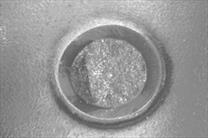
All of these factors must be considered when evaluating a brittle weld finding. A result that appears brittle under one test condition may not replicate under another — which is why consistent, standardized test procedures are critical for meaningful comparison.
The underlying metallurgical causes center on rapid cooling. When any combination of weld current, weld time, and electrode or workpiece cooling allows the nugget to cool too quickly, the resulting microstructure can be martensitic or otherwise hardened in a way that sacrifices ductility. Higher carbon content and certain alloy chemistries increase this risk significantly. In some cases, the workpiece chemistry is simply not well-suited to resistance spot welding without specialized schedule development.
Brittle welds frequently fracture interfacially — at the weld plane rather than through the base material — which distinguishes them from sound welds that fail by button pullout or base metal tearing.
How to Detect Brittle Welds
Brittle welds are most reliably identified through destructive testing. The characteristic indicator is a granular fracture surface with little or no evidence of stretching, yielding, or plastic deformation in the surrounding material. A sound weld under the same test conditions would show a ductile failure mode — fibrous tearing, button pullout, or base metal fracture away from the weld zone.
Non-destructive detection is not reliable. Brittle welds can produce a normal-looking electrode impression and pass visual inspection entirely. Periodic destructive testing and strict parameter control are the primary quality assurance tools.
How They Affect Spot Weld Quality
Brittle welds are among the most serious weld quality failures in structural and safety-critical applications. Because they are not detectable without destructive testing, and because their failure mode is sudden fracture under load rather than a gradual ductile failure, they represent a direct safety risk in crash-critical automotive body-in-white locations.
Quality and safety are the primary concerns. Cost, downtime, and throughput follow when destructive testing reveals the condition across a production run and parts require scrap or rework disposition.
From a maintenance standpoint, recurrent brittle welds on a specific station warrant a full review of the welding schedule against the current workpiece material specification — particularly if the material has changed since the schedule was originally developed.
Subordinate Causes
Strong Possibilities
Weak Possibilities
Other Possibilities
- Prior working/heat treatment
- Rapid cooling caused by any combination of weld current, weld time, and electrode (or workpiece) cooling that permits rapid weld cooling
- Welding schedule not suitable to workpiece chemistry
- Workpiece chemistry not suitable for resistance spot welding