

Mislocated and Edge Welds in Resistance Welding
A mislocated weld is one that is incorrectly positioned relative to the current workpiece design. Edge welds are a specific subset — welds that touch or extend beyond the edge of the workpiece. Both conditions represent positioning failures, but edge welds carry additional risk: they are a known contributor to expulsion and can generate significantly more spatter than a properly located weld.
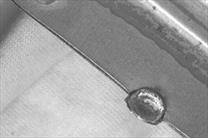
Detection
Pre-weld observation of tip position on the part is the first line of defense — catching a positioning problem before the weld fires is always preferable to finding it after. Post-weld visual inspection confirms whether completed welds are correctly located or extend beyond the workpiece edge. Refer to applicable company standards for edge weld acceptability criteria.
Why It Matters
Mislocated welds can affect NVH performance, sealing integrity, and the fit of downstream components such as rubber seals. Edge welds in particular can compromise flange strength and interfere with sealing surfaces. Depending on location and assembly function, either condition may require rework, re-weld, or part rejection.
Where to Start Troubleshooting
The strong-possibility causes fall into three areas.
Part positioning and fixturing — Wrongly located welds — whether from fixture drift, robot programming error, or operator placement — are the most common cause and the first thing to verify. Check weld location against the applicable drawing before investigating equipment. Poor or varying part fit-up can shift the workpiece out of position relative to the electrode, producing a weld that is correctly programmed but incorrectly placed. Confirm that parts are seating consistently in the fixture before each weld cycle.
Electrode alignment and geometry — Electrode faces not parallel to the workpiece and inadequate electrode alignment both shift the effective weld contact point away from the intended location. Wrong tips — incorrect face diameter or profile — can place the contact zone at the edge of the flange even when the electrode is correctly positioned. Verify electrode alignment, face geometry, and tip specification against the application requirements.
Flange and accessibility — A weld flange that is too small leaves insufficient material between the intended weld center and the part edge, making edge welds likely even with correct positioning. Poor weld accessibility forces compromised electrode approach angles that shift contact location. If mislocation is systematic rather than intermittent, evaluate flange width and electrode approach geometry — these are design or tooling issues that process adjustment alone won’t resolve.
Full Cause List
Strong Possibilities
- Electrode faces not parallel to workpiece
- Inadequate electrode alignment
- Incorrect workpiece selected
- Poor or varying part fit-up
- Poor weld accessibility
- Weld flange too small
- Welds wrongly located by fixture/robot/operator
- Wrong tips
Weak Possibilities
Note: Edge welds can cause high levels of expulsion.