

Undersized Welds in Resistance Welding
An undersized weld occurs when the nugget or button diameter fails to meet the applicable specification. The weld nugget is the fused volume that joins the workpieces; the button is the material that remains attached to the fused zone after destructive sheet separation. These are related but distinct measurements, and the applicable specification will define which is required and how it’s measured.
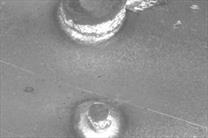
Detection
Button diameter is determined by measurement after teardown. Nugget diameter requires sectioning the weld. Consult the applicable specification for the correct measurement method and minimum size requirement.
Why It Matters
Button diameter is the primary in-plant metric for controlling spot weld quality. An undersized weld is by definition an out-of-spec weld — it affects structural integrity, triggers quality holds, and depending on frequency and location, can have significant cost and throughput implications.
Where to Start Troubleshooting
The strong-possibility causes fall into four areas. Work through these before moving to the full list.
Weld schedule — insufficient heat input — Low weld current, short weld time, and high weld force are the most direct schedule-side contributors. Too little current or time means the nugget never reaches the diameter required by spec. High force increases contact area and reduces current density, which has the same net effect — less heat at the weld interface. If the weld schedule hasn’t been verified against the current material stack and thickness, start there.
Electrode and mechanical condition — Electrode wear, incorrect electrode face geometry, and electrode faces not parallel to the workpiece all change the current density and force distribution at the contact point. Skidding or sliding electrodes compound the problem by moving the weld zone mid-cycle. Inspect electrode face condition and seating, and verify that face geometry matches the weld schedule spec.
Electrical and mechanical connections — Poor electrical connections and poor mechanical connections both introduce resistance losses upstream of the weld. Shunting — whether from adjacent welds or from the gun itself — diverts current away from the intended weld zone, reducing available heat. Check all secondary circuit connections for condition and tightness, and evaluate weld spacing if shunting is suspected.
Part and material conditions — Dirty material, excessive sealer, incorrect material or coating, poor part fit-up, and damaged parts all interfere with current flow or contact at the faying surface. Poor weld accessibility can limit electrode seating and force delivery. If the weld schedule is correct and equipment checks out, shift focus here — particularly if the issue is intermittent or station-specific.
Possible Causes
Strong Possibilities
- Damaged part
- Defective air or hydraulic system
- Dirty material
- Electrode faces not parallel to workpiece
- Electrode skidding/sliding
- Electrode wear
- Excessive sealer
- Incorrect cylinder
- Incorrect material/coating
- Incorrect test procedure
- Insufficient cooling
- Poor electrical connections
- Poor mechanical connection
- Poor or varying part fit-up
- Poor weld accessibility
- Shunting of guns or parts
- Weld current low
- Weld force high
- Weld time short
- Wrong tips
Weak Possibilities